Search This Blog

Wednesday, 8 January 2014

THE DIFFICULT TIMES

Pre Katrina from the net


If everything had been as it was meant to be, he wouldn't be here. The malicious cackle of an old woman, witch-like. "Wake up boy." And the laughter, delighting in some sort of retribution. As his uncle slept the sleep of the inebriated on the couch, snoring gently, smelling of nicotine. He had left his wife of 45 years for t he umpteenth time; and would no doubt return to her in the morning. Spooked by the sound of the laughter, he thought: "It's no wonder, some of the shit you're into, that you've been occupied by spirits." But no doubt it was just a dream, of country origins, of the old women who had once been a part of everybody's life, but were now relegated to homes, to the company of each other. The dying, the dead. The voices of their youth. None of which they had realised would be fleeting.

He still woke up sometimes with angry denouncements of the thugs and thieves he had the misfortune to fall in with, or more precisely out with, during his sojourn in Thailand. Thugs and thieves, that's all they had been, even, or most particularly, the police. But that was the way of a country that wasn't his; not that he felt any less out of sorts here than there. They culd make of it what they would. His uncle was planning to go up to Murwullumbuh on the North Coast, where the family had originated from. Back to their roots. To a place that in his imagination, in the f amily's imagination, still represented home. But in the acres, in the creeping light, in the drenched colours of the coast, there would probably be no more comfort than there had been in the past.

"One door shuts and another opens," he said, sitting outside on the small stone wall. All around were the too-quiet houses. He never heard any music here; and most of them looked as if they were in bed by 9pm. He couldn't bear the silence, which he equated with threat. But it was a time, a sojourn, that could not be undone, that had to be endured. Not a ritual humiliation so much as a quiet time, where everyone knew their place. Where, in the feudal culture through which he had skated, everyone could jeer at anyone who stepped out of line. But in Australia they had grown up with the myth of egalitarianism, that everyone was equal before the law and before God. But how this would equate to a barren, financially stripped future, no one had known.

Australia had once been a worker's paradise. The cars and houses accumulated. Builders, labourers, plasterers, cementers, they had all been hauling in the cash and spending it on their multiplying hordes of children, their increeasing assets. But that world had gone. The former Prime Minister, Kevin Rudd, had repeatedly claimed to have saved the country from the Global Financial Crisis. But the streets of this suburban country were already in depression. The money had already disappeared. Both sides of government had imposed regulation and regulation, law after law, until there was no room to move. No black money sloshing around. Little but micro margins and increasing despair. Or satisfaction with mediocrity. No glistening utes lay casually parked in front yards anymore. Children didn't play with expensive toys. Wives didn't think a trip to the hairdresser was a life essential anymore. They had been told their identity was tied up with work; and in the end there was no choice, they had to work whether they liked it or not. The dead hand of socialism, of grotesque levels of taxation and regulation, had stripped the country of much of its laissez faire character. And so he waited, and watched. And heard in the distance the dying bewilderment of thugs and thieves, as they moved on to other targets; saving face.

THE BIGGER STORY:

From The Conversation:


The terms on which the broader public conversation is taking place are remarkably narrow. Robyn Ramsay
In most public discussions, the issue of same-sex marriage is posed as a simple question – for or against? – where to be for oragainst is to be, more or less, for or against gay people. Although it doesn’t get much airtime beyond queer counterpublics, there is an adamantly left-wing, progressive and pro-gay perspective that suggests same-sex marriage is not a necessary good.
As Leader of the Opposition, and now Prime Minister, Tony Abbott has consistently opposed the legalisation of same-sex marriage, so far refusing to allow MPs a conscience vote on the issue. In late October and despite the fact that such marriages had no legal standing in Australia at the time, Christine Forster, Abbott’s lesbian sister, announced her engagement to her partner, Virginia Edwards, via a photo-spread in New Idea.
darcyandkat
Click to enlarge
Events – as we know – have moved swiftly since then. TheACT passed laws legalising same-sex marriage, which will be effective from today, although within 24 hours of the legislation’s successful passage the federal government had lodged a writ in the High Court challenging the constitutionality of the new legislation.
Days later, a pan-political working group introduced to the New South Wales parliament a bill allowing same-sex marriage, which will be debated this week. Like a consciousness-raising plot twist in a socially progressive soap opera, the Tony/ Christine narrative offers a familial inflection to a set of political issues currently being played out at national and international scale.
Yet the terms on which this broader public conversation is taking place are remarkably narrow.
Since the 1961 Marriage Act, the definition of marriage in Australia is:
the union of a man and a woman to the exclusion of all others, voluntarily entered into for life.
A lot of attention has focused on that opening phrase — “the union of a man and a woman” — but we need to look as carefully at the rest of this almost entirely fanciful definition. Defining marriage in terms of exclusivity and permanence is, at best, a wishful description; it’s an idealised account of how we, individually and collectively, hope marriage might work.
The credibility gap between the soft-focus idealisation of marriage and its grittier realities suggests something of the scale of bad faith implicit in public discussions of marriage. Lesbian and gay communities, and the feminist communities with which they have historically overlapped, have long celebrated the values of sexual diversity over the sexual conformity represented by marriage and the ethical importance of sexual straight-talking rather than the double-standards so frequently observed in marriage’s vicinity.
Gay men and lesbians can sneak around with the best of them, of course, but marriage, as it is legally defined, generates conditions for dishonesty, disavowal and sexual hypocrisy.
WehoCity
Click to enlarge
There’s a tendency among its proponents to represent same-sex marriage as the final chapter in the story of gay acceptance, “the last civil right” as it has sometimes exaggeratedly been called. But marriage today has been strongly shaped by the social and sexual everyday life experiments of those groups of people who, across the long 20th century, have chosen or been required to organise their sexual and social lives in post-traditional ways outside the institution of marriage.
It is in large part because of feminist and gay innovations in living that marriage today is increasingly understood not as a religious but a social relation; characterised not by male domination but equality and mutuality between the sexes; valued not in terms of its contractual basis but in terms of its ongoing contribution to a person’s sense of well-being; and maintained not until death-do-us-part but for as long as both parties find satisfaction in it.
Rather than admit lesbians and gay men to marriage as currently conceived, we should avow more fully the range of options that characterise a lot of our lives and living arrangements. Why not support and recognise the alternative intimacies that gay communities, among others, have been developing for decades?
To extend the conformist embrace of marriage to same-sex couples is to lack imagination.
The UpTake
Click to enlarge
The argument in favor of extending legal marriage to same-sex couples depends primarily on wanting to extend the benefits and privileges of marriage to lesbian and gay couples. But it must be recognised that this comes at a cost. Allowing gay men and lesbians to marry will not stop marriage from being exclusionary.
That’s because marriage is not a private matter. Despite the fact the decision to marry — like the desire to marry — is experienced by most people as an intensely personal one, marriage is in fact a public institution and has significant implications for those outside its circle of privilege and recognition.
In recognising some gay and lesbian relationships as marriages, same-sex marriage emphasises the continued illegitimacy of other sexual arrangements and the continued exclusion of other social actors. The legalisation of same-sex marriage has risky consequences that exceed the good intentions of many of those arguing for it.
August Allen
Click to enlarge
Therefore, the recognition of same-sex couples through marriage is not a wholly benign or even a neutral act because, like the historic form of marriage itself, it recognises the worth of some relationships by valuing them more than others.
Outside the newly enlarged circle of social approval and privilege afforded by same-sex marriage stand those whose erotic lives are not organised around the values symbolised by marriage: coupledom, monogamy, permanence, domestic cohabitation.
Unmarried mothers, for instance; adulterers; the devotedly promiscuous; sex workers; the divorced; the bigamous and polygamous; those who are not strangers to the august traditions of the dirty weekend or the one-night stand; single people.
Now this ragtag bunch might not seem as worthy of social protection and prestige as the loving, caring, long-term gay and lesbian couples that are the shiny new poster boys and girls for same-sex marriage. But it reminds us to ask something that advocates of same-sex marriage, in their eagerness, forget to ask: why should marriage continue in the 21st century to be a primary mechanism for the distribution of social recognition and privilege?

Monday, 6 January 2014

THE RAVISHING


Clunes, NSW, Australia
And then, with rhythms away, he came crawling there, through, not in the beds of old friends, as in the past, but on couches, travelling, always travelling, becaeuse he had always taken any opportunity to go anywhere, but now, when he could feel the ancient drones crawling beneath his skin, he declared of selling, having sticky taped up posters for Keysar Trad's Forays of the Heart around Glebe, "Humble Yourself Before God". His friend Michael immediately replied with a quote from Dostoyeskvi, something about throwing yourself on your knees in the market place. They were sitting outside his shop Afghan Interiors on Southern King Street. Like so many others, they were having a Closing Down Sale. There were For Sale signs and For Lease signs everywhere. Some people just didn't bother with anything. They just closed their doors and walked away from their dreams, investments, life blood..

"What is it?" he asked Michael. "It's not just my imagination. People have no money."
"Exactly," he said. "Look around here."
And they looked around the cluster of trying-to-be-trendy shops of Southern King Street, Newtown; a section which merchants had always hoped would become as fashionable and as crowded as Northern King Street, but it had always failed.
"Their behaviour changes as they get more desperate," Michael observed of his fellow shop owners. "Nobody's got any money."

He could feel it, he could see it. And often enough, he would espouse further. "Over regulation. I blame the GST. Every vibrant society needs cash money sloshing around."
They weren't views that got any sympathy. They would rather die of boredom and live in a society hoovered of money and enthusiasm than think that someone else was getting something more than they were; weren't paying their fair of tax. So the bureaucrats and politicians could dance on the world stage.

Except, of course, for Suzy, who had just moved into an empty four storey terrace in The Rocks, nestled in an atmospheric little nook of prime real estate just near the Harbour Bridge. "Housos," they would say to each other, proud of it. 

"Someone's looking at my stomach," a drunken man declared to his friend, hitching up his torn jeans.

Proud of it, proud of the gurgles down which their lives had gone. He didn't want to be near them anymore.

"How do they do it?" a wealthy woman asked her hsuband as they passed by.
"They just walk right in," he thought.
"The poor live like kings," Suzy declared, victorious. That the vacated property was occuped again was now a Department of Housing problem.

But no matter how good the view, how spectacular the location, he didn't want to live anywhere near any of them anymore.

THE BIGGER STORY:

Prince Harry has begun his first official trip to Australia by joining centenary celebrations to mark its navy's arrival at Sydney Harbour.
He was greeted by huge crowds as he embarked on survey ship HMAS Leeuwin at the city's Garden Island naval base, before inspecting the flotilla.
The International Fleet Review involves some 40 warships from 17 countries.

After a 20-odd hour flight Prince Harry spent much of the day at sea aboard one of a flotilla of Australian warships in Sydney's magnificent harbour.
He is here as guest of honour for the Australian navy's International Fleet Review.
In a day of pomp and ceremony, dignitaries were offered a 100-gun salute to mark the centenary of the navy arrival into Sydney Harbour back in 1913.
These waters have rarely seen so much traffic. Navy ships from countries around the world joined the Australian fleet to take part - including the Royal Navy's destroyer HMS Daring.
The event has attracted huge crowds with up to a million people expected to have turned out.

The event is the only scheduled public appearance for the prince, who is representing the Queen.
A 100-gun salute marked the start of the celebrations, and Prince Harry was joined by Australia's Governor-General Quentin Bryce on board the Leeuwin to officially review the fleet.
Some 16 tall ships and 8,000 sailors from around the world have been taking part in the event, with warships from countries including the US, China, France and India. Britain sent one of its largest ships, the Type 45 destroyer HMS Daring, to represent the Royal Navy.
An estimated 1.4 million spectators were expected to line the banks of Sydney harbour for the celebrations, which finished with a light show and display involving 7.7 tonnes of fireworks.
'


Saturday, 4 January 2014

THE PLACES FLED XII

Illawara, NSW, Australia
He had already fled the obscene places, of flash and trash and inebriated laughter. He already knew there wasn't any salvation in dissolution; that their drunken heroes of the past had died young and may have left their streaks of genius, their scribbles in the sand, but that was all. We took one step at a time into a greater life. He wasn't depressed anymore; and didn't know who he was. Of paramount importance, whatever it had been. They came crawling through the gutters, underneath the doors. Their howling choruses, their dark traces. He was fragile and yet important, invisible yet still there. At last he could resume his rightful place in the ceiling, the eternal observer; quiet, nobody knew he was there. And so every drunken legend passed away. And he slept like a normal person. Torrid disentangling dreams; of Carolyne Overington, for God's sake, how much did you make from that last book, he was demanded, in some small News Limited room. Before everything went away.

And then, and then he didn't know anymore. He could still hear them far away, disentangling with the morning radios, the morning news on the television, people getting ready for work. He didn't believe what ha happened; and if he was privy, wouldn't have believed what was to happen next. But each day remained in the fervent present, if it could be called that, well, unique days working quietly, all the way, all the way. As torrid as it was, he couldn't go there, not back to the past, not anywhere. There was a system that made this worthwhile, a system which would rescue him from wherever it was. A dark disentanglement of financial lines, obligations, commitments, of tightness flowing from extravagance, of a past of unappreciative vultures, slimy little thieves, horror show faces he would never trust again, a disentangling, disparate string of irreverence and disregard, of contemptuous, disrespectful voices raised up in a chorus, of liars he had temporarily, occasoinally believed, and of an overwhelming sadness. He had wanted to drink himself to death; indulgent as that now seemed.

In the past, in the past. Some days that was all there seemed to be. His mother was in her eighties and all her friends, people she had spoken to almost daily for decades, were shuffling off the mortal coil. "Dear father," she gasped at the kitchen sink one evening, as his drunken uncle called on their services. Dear father, as in take me to the rapture. "My friends aren't doing well," she observed, suddenly frail again. As if life was folding in upon them. As in the acres, in the streams and screams of discontent, there was nothing but a dissolution of all that had once been. "It's a dying world," she would say. But then, he had been in Nepal, where swarms of children ran and played under giant mango trees, playing cricket on a makeshift pitch, the souns of their games caught in the overwhelming air. Sometimes he would find a little bar and make waste of himself, a pathetic attempt at communication. We drank for company and ended up alone, the old saying went, and for him it was often true enough.

Pictures of Lumbini, Buddha's birthplace, still floated through his head, as if he would rather be there and here. Yet, for whatever reason, he was meant to be here. What, to reorganise, regroup, to face the penalties for his mistakes? He didn't much know, and didn't much care; because every day was vivid in its own way; and as he had put it in an email to an old lover, life remained interesting. If not exactly affluent; not always fulfilling. We get what we need, not what we want, was another old saying that drifted through jumbled dreams; and all in all, was here because he had been there. It had come as a surprise that he missed the routine of work. Perhaps he was made for greater things, but remained frightened. Perhaps he had run his course, and it was for someone else to watch the entrails rot into the desert sands. He didn't know. Do the best by the day. All these things, of unsanctioned love lost in bars and clubs and disappearing into disco beats; flocks of queens cawing at each other, ancient devices, old fashioned corruption, chambers in which he had no desire to dwell, a prisoner in a former life. He still paced, just as his ancestor had done. And waited, sometimes, for life to happen. And in the meantime worked.

THE BIGGER STORY:

http://qz.com/130149/why-thailand-uses-slaves-from-myanmar-to-peel-its-shrimp/

In some ways, Thailand is a fairytale of economic development. Thanks in large part to exports, its GDP per capita is now eight times what it was in 1980. Its people live 15 years longer than they did in 1970. They’re now better educated, so they are doing more high-value jobs. It’s also an exemplar of family planning; 80% of the reproducing population uses birth control, compared with just 15% in 1970.
+

Which helps explain why Thailand’s unemployment rate is just 0.9%—the lowest among the world’s major economies.
+

But the upshot is that Thailand desperately needs cheap workers to keep growing. Thais are too educated and too few to do the menial jobs.
+

The solution? Migrants. And the cheapest of all are undocumented, trafficked and often forced laborers from Myanmar, and, to a lesser extent, Cambodia and Laos.
+

Thailand’s shrimp-peeling business is a classic example, as the Environmental Justice Foundation, a non-governmental organization, highlighted in a recent report (pdf). It’s a critical industry for Thailand, which typically produces one quarter of the 2.6 million or so tonnes (2.9 million tons) of the planet’s annual shrimp output. Some 90% of that goes abroad, making Thailand the world’s biggest exporter of shrimp. That brought in $3.5 billion in 2011, just shy of 1% of GDP.
+

Most of that shrimp enters importing markets already peeled, beheaded, deveined and gutted.  But dismantling tiny crustaceans is laborious. The conditions in “peeling sheds,” reports the EJF, are noxious, the hours long, and the pay dreadful.
+

Unsurprisingly, Thais long since stopped taking those jobs. Migrants, mostly from Myanmar, can earn more there than they would at home, and thus send money to support their families. Though Thailand’s estimated 3 million migrants make up 10% of its workforce, in seafood processing, they compose 90%.
KEVIN Rudd's brother says when it comes to the leadership ambitions of his sibling, the Australian people should "never say never".
Greg Rudd - who unsuccessfully bid to become an Independent senator at the September election - said that while he had "no idea what's in his head", his brother's hunger for leadership may still be unsatisfied.
"All I'll say is that while he's still in politics, you can't rule anything out," Mr Rudd said from London.
"It's like (Sean Connery) when he said he'd never play James Bond again and the lesson of that was that you never say never. But I have no idea what's in his head. A lot of it will depend on the upcoming leaders."
Greg Rudd took aim at the "showbiz" style of his brother's election campaign, saying much of it was about "trying to run the news story of the day" and instead Kevin "should have focused on policy".
Mr Rudd said the controversial Northern Territory economic zone policy and the Brisbane navy plan were examples of that.
"Because they hadn't been out in the public arena and there hadn't appeared to be a lot of deep thought and discussion about them, it looked as though, to all and sundry, that they were just ideas and thoughts that were just coming out on the spur of the moment because they might have a political effect," Mr Rudd said.

Friday, 3 January 2014

THE PLACES FLED XI

Coniston, NSW, Australia

Well, gorgeous strides, a brain in a continual state of obsession, a last laugh, a final echo, these things, the crow cries, the call of other names, a distant shiver in a dark place, all of it, reward for what? He didn't much care now what happened. Yes, he still dreamt of the same things in an endless loop. "Make fun of the falang, make fun of the falang." They just wouldn't leave him alone, the nasty parasites, the corrupt police. They stole from him at every opportunity, and thought it was funny. Haunted and without sleep, he made poor decisions. His drunken uncle said: They sell people drugs and then if the person bites, they come in and bust them, or get money off them. Yes, I know, he said. They're unbbelievably corrupt. And of course their government condoned it, backed them, and they swashbuckled, as if proud of their own power. If power to be absurd, to make a fool of yourself, was really power.

None of it mattered now, but his head remained frozen in a loop. Because he wouldn't be here if he hadn't been there. And that, perhaps, was the key to everything. That the hoola hoop would finally roll on out of the yard. That another turn, another place, would become part of the ravishing, That tired, unkind thoughts of nasty, vicious, unpleasant people would finally curl away into the shambles of other lives. He shuddered at what had happened, but couldn't rewrite history. Their own disregard for decency was already known. If the haunting had not gone on for so long; perhaps it would not linger still. A sharp intake of breath. A fetid bow. Love lost, a love that never was. They laughed. He shuddered. And perhaps it was always thus.

In the unbelievable circumstances, when every little shred of a former self cried inside, funnelled through to a present when he loudly declared: "I had a nervous breakdown. Do your worst, you bastards." And the sick seas of the crowds just escalated their howling, and he stared straight through them: because no escape was possible. They were everywhere, in every part of his life; and the damage they did, there was no compensation. They could say what they liked, he didn't care. There was a cemetery awaiting for them all, for the entire cast and crew, including him. Time would blink and they would all be gone. Marketing campaigns would pass across the land, and delusion remain paramount. But none of it meant salvation, or a better place. They would leave the earth, their country, a worse place.

And so when he came to it, to dealing with what had happened, he let his head go on in an eternal loop. An intoxicating beauty. The mumble of a distant television. Voices in the air which could have been radio waves; they were so muffled, so far away. Because time would cure everything, he already knew that. Time would cure everything, an ancient pass on a football field, a cruel distance in a solid land, a pass that should never have been. His spirit was everywhere now, on an ancient Greek field, in a modern Thailand, on a lonely Australian beach. He could feel them moving beyond the realm of sight, the others. He knew now why Mervyn Peake went mad at the end of his life. He knew now why village boys were nothing but thieves, why desire became so random with age, why crowds could be so easily manipulated. He knew now that there would be no peace, but there would be triumph. And he knew now that their faces had already changed; dust to dust, ashes to ashes, a brutal turning of the switch, and all was gone.

THE BIGGER STORY:    

http://www.boston.com/ae/celebrity/2013/10/02/best-selling-author-tom-clancy-has-died-age/RsGU3JsQs6ZxsKSqAyzOUI/story.html

NEW YORK (AP) — Tom Clancy, whose high-tech, Cold War thrillers such as ‘‘The Hunt for Red October’’ and ‘‘Patriot Games’’ made him the most widely read and influential military novelist of his time, has died. He was 66.
Penguin Group (USA) announced that Clancy had died Tuesday in Baltimore. The publisher did not provide a cause of death.
Tall and thin, with round, sunken eyes that were often hidden by sunglasses, Clancy had said his dream had been simply to publish a book, hopefully a good one, so that he would be in the Library of Congress catalog. His dreams were answered many times over.
His novels were dependable best sellers, with his publisher estimating that worldwide sales top 100 million copies. Several, including ‘‘The Hunt for Red October,’’ ‘'Patriot Games’’ and ‘‘Clear and Present Danger,’’ were later made into blockbuster movies, with another based on his desk-jockey CIA hero, ‘‘Jack Ryan,’’ set for release on Christmas. Alec Baldwin, Ben Affleck and Harrison Ford were among the actors who played Ryan on screen.
A political conservative who once referred to Ronald Reagan as ‘‘my president,’’ Clancy broke through commercially during a tense period of the Cold War, and with the help of Reagan himself. In 1982, he began working on ‘‘The Hunt For Red October,’’ basing it on a real incident in November 1979, in which a Soviet missile frigate called the Storozhevoy attempted to defect. He sold the manuscript to the first publisher he tried, the Naval Institute Press, which had never bought original fiction.
In real life, the ship didn’t make it, but in Clancy’s book, published in 1984, the defection was a success. Someone thought enough of the book to give it to President Reagan as a Christmas gift. The president quipped at a dinner that he was losing sleep because he couldn’t put the book down — a statement Clancy later said helped put him on the New York Times best-seller list.
Clancy was admired in the military community, and appeared — though he often denied it — to have the kind of access that enabled him to intricately describe anything from surveillance to the operations of a submarine. He often played off — and sometimes anticipated — world events, as in the pre-9/11 paranoid thriller ‘‘Debt of Honor,’’ in which a jumbo jet destroys the U.S. Capitol during a joint meeting of Congress.
Earning million-dollar advances for his novels, he also wrote nonfiction works on the military and even ventured into video games, including the best-selling ‘‘Tom Clancy’s Ghost Recon: Future Soldier,’’ ‘'Tom Clancy’s Splinter Cell: Conviction’’ and ‘‘Tom Clancy’s Splinter Cell: Double Agent.’’ His recent Jack Ryan novels were collaborations with Mark Greaney, including ‘‘Threat Vector’’ and a release scheduled for December, ‘‘Command Authority.’’

http://www.boston.com/ae/celebrity/2013/10/02/best-selling-author-tom-clancy-has-died-age/RsGU3JsQs6ZxsKSqAyzOUI/story.html

Australian Prime Minister Tony Abbott has described the relationship with New Zealand as "like family" after a meeting with John Key today.

The New Zealand Prime Minister touched down in Canberra this evening, the first foreign leader to meet the new Australian Prime Minister Tony Abbott on home soil.

"New Zealand is family in a way that probably no other country on earth is," Abbott said after the leaders met.

ONE News political editor Corin Dann, travelling with Mr Key, says it is a very important meeting for Mr Key "because it is that first chance to really strike up some chemistry with Tony Abbott as Prime Minister and to see how he is going to operate in that role".

Mr Key says it's important the two leaders develop a chemistry and therefore regular contact.

"This is a tremendously important relationship from New Zealand a perspective, no relationship is more important," he said.

Abbott said he would accept an invitation to come to New Zealand next year.

Kiwis in Australia

New Zealanders in Australia ineligible for welfare benefits look unlikely to receive fairer treatment anytime soon, with Prime Minister Tony Abbott saying he's happy with the situation.

There are 300,000 Kiwis on special category visas in Australia, paying billions in taxes but denied key benefits of permanent residency, such as disability care, welfare and social housing.

Australians living in New Zealand receive all the entitlements of citizens.

Thursday, 2 January 2014

AUSTRALIA DAY

Add caption
Central West, NSW

AUSTRALIA DAY

Central West, NSW

AUSTRALIA DAY

Central West, NSW

AS IF IN AN INFINITE STORE

1500 Skies - random pic from mom's computer
As if, as if, we could see through everything. He returned to the toxic shores, and just as before, everything went haywire. Just as the boy in Equus had spiked out the eyes of the stable horses, so he spiked out the eyes of those who watched him. And then was pursued across the fetid kingdom, with no place to hide. Hunted from one place to another, the scandal of the blinding growing with each telling. They may have been wild dreams, the cruelty espoused, exposed, and there was no use telling anyone they had brought it upon themselves. He had once more become the hunted. There wasn't anything fair about it. Fairness didn't come into it. Vulnerability did. Just as jackels attacked the wounded, so they attacked the vulnerable, the elderly, the miserable, the heart broken. "I'm disturbed by this, Thailand is meant to be a welcoming country," a young man said in a stairwell in Patong.

But disturbed or not, there would be no intermission, no relief. A long spike, a distant place. He had never blinded humans before. From people he had no intention of ever seeing again. "The police there are unbelievably corrupt," he said to a drunken uncle on the lawn. As in: if the cap fits, wear it. There wasn't going to be any easy solution. Moving across space and time. Flashes of anger replaced by flashes of resilience. A toxic dream, a toxic place. Or not. He missed the visual tableaus, the crowded streets, the sense that anything could happen. He didn't miss the howling chorus of the apes, the easily seduced. The moo like menaces who crowded on every street corner. He didn't miss the infinite sense of longing that distorted everything he touched. And he most certainly didn't miss the derision, the nasty coating that came from everywhere.

Back here, he walked through avenues of the past. He had barely been in Australia for years, barely been amongst native English speakers for years, but again there was little to say, little to communicate. He had no great desire to say anything. His drunken uncle had never been the same since his first wife had died more than 45 years before; in a car accident which destroyed their lives. They had been a very dashing couple, a handsome pair. He had only been a boy then, staring in misery out the window of his parent's car. All was not lost, but it might as well have been. Back then he hadn't known how there was going to be any remorse, redemption, a way through. What a chorus, what a place.

Last night Des left his next wife on again; as he often did. "Have you two been drinking?" his mother asked in some rare display of innocence, or was it politeness. "You bet," Des said, or slurred words to that effect. Showing all the communality of the working class, except they didn't work. "Housos," after a successful television series, was the term. Bleak, suicidal, was the way he thought of the houses, the areas. Nothing to do, nowhere to go. The blinding of the vindictive bastards who had made his life hell was just a dream, a dream of parasites and lechers, of drunken police and corrupt government officers. They were dreams he wished would die off into another place; but kept returning. Because he wouldn't be here if he hadn't been there. Because nothing had made much sense at the time; and still did not. And perhaps because he could say what he wanted in the so-called "land of the free"; in a democracy which encouraged debate and disparate views; freedom of expression. Well that was the theory anyway. Doe like eyes stared at him wherever he went. And he could feel the spike and the blood on ghostly hands. And something which might easily have been regret.

THE BIGGER STORY:

https://news.google.com.au/nwshp?hl=en&tab=wn

President Obama says he's tired of the seemingly never-ending rounds of budget crises.

"When it comes to Congress paying its bills ... we cannot be a country that is lurching every two months or three months from crisis to crisis to crisis," Obama said in an interviewMonday with NPR's Steve Inskeep.

Yet that is precisely the situation the president finds himself in.

As of midnight Monday, much of the federal government is now shut down for the first time since 1996.

Members of Congress will face intense pressure to work out a deal — particularly with a debt ceiling limit set to be breached by midmonth.

Obama says he'll hold firm and not give in to House GOP demands that any budget package contain language delaying parts of his signature health care law, the Affordable Care Act, also known as Obamacare.

The president said he "shouldn't have to offer anything" in response.

"They're not doing me a favor by paying for things that have already been approved for the government to do," Obama told Inskeep. "That's part of their basic function of government; that's not doing me a favor."

http://www.theguardian.com/world/2013/oct/01/tony-abbott-asia-pacific

It was either the new face of Tony Abbott, or the familiar face of an Australian politician. Or perhaps it may be the naivety of Indonesians, most of whom still believe that in a democracy politicians actually carry out their most stringent campaign promises.
Either way, Abbott showed a different side on his high-profile visit toIndonesia on Monday. Gone was the boisterous opposition leader. In stepped a figure befitting a leader of the most advanced nation of the southern hemisphere. Infused with deference. Careful in his words, prudent in his mannerisms.
Abbott's first visit to Jakarta since taking office achieved little in substantive results, yet accomplished much by way of reinforcing a closer working relationship with his counterpart, President Susilo Bambang Yudhoyono.
It was, in essence, a foundation-laying visit. Not a problem-solving one. Some critics have even suggested it was diplomatic appeasement.
From an Indonesian perspective, it was a welcomed visit. Without spectacle, bereft of controversy.
Given the narrative which catapulted the Liberals to power, there was some suspense – no matter how unfounded – that during his visit Abbott would coarsely push the issue of people smuggling in the same way he claimed he would push boats back into the sea.
But we have all learnt something. Abbott has learnt there is a difference between the boisterous style of campaign rhetoric and the delicacies of high government.
The Indonesian people have also learnt they have nothing to dread from the new Australian leader, who showed appropriate tact during his visit. That Abbott comes from a generation of Australian leaders who appreciate the complexities of the giant archipelago to their north, in the manner of Keating, Howard, Gillard and Rudd – leaders who fathom that a quiet suggestion goes farther than a flamboyant warning.
  

Wednesday, 1 January 2014

DEEP RESENTMENTS

oo
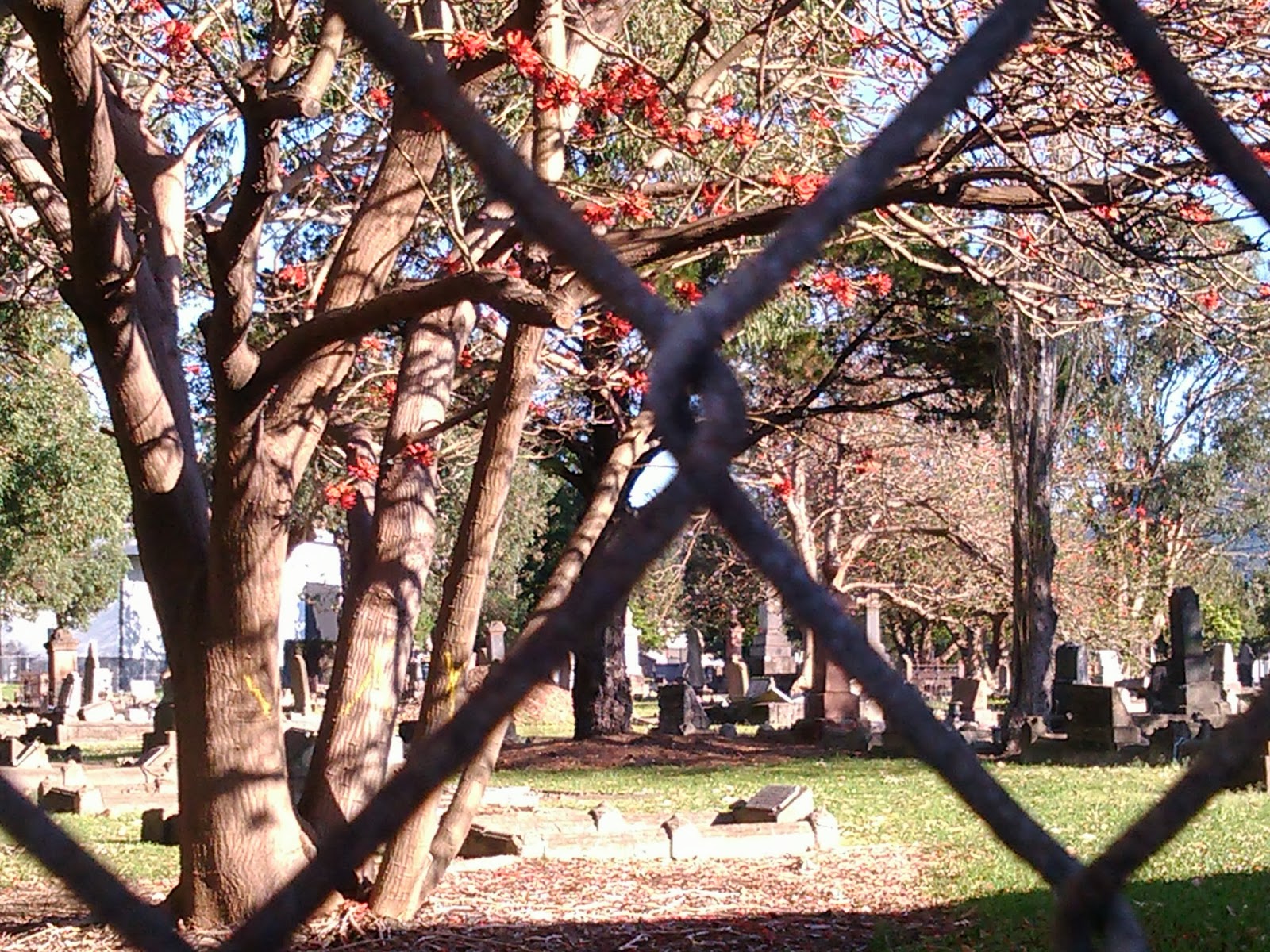
Cemetery, Conistan, NSW, Australia
He was always looking in at other people's lives, even the dead. Just passing through. He envied them their stolidity, their established purpose, the rotines and comfortability of knowing who they were. Always, in these stark reaches, there was someone else calling. It had all gone on for too long; the harshness, the unfolding disaster. Someone had to reach out and say a kind word. But of course they never did. Plucked at by ravaging dogs, by jackels hunting in packs, vermin snapping at the edge of the herd, always there, always there, his own mind racing towards a fulfilment that never came, always in this dazzling cruelty, the baying of the pack, there was a kind of salvation in moving on. They were rough climates, rough ledges. There was determination, grit as a new study called it, a forlorn flapping of wings in the higher reaches; something that could be called but was already gone; and that was it.

He's sitting on a gold mine, someone said, but he shrugged and ignored them, as he had so many others. They had backed away but they had not disappeared. Not yet. Frightened, yes he had been frightened, as the camp dogs picked over his already decomposing flesh. Frightened that so far away in so many places, he could hardly resonate without colour, could hardly claim to have even been alive. Time telescoped at the beginning of life. "How do you look back on it all?" Martin asked. "I remember you fondly," he said. And they retold tales from their chaotic youth, hitting him with a typewriter, trying to run him over, fleeing, fleeing, in the empty spaces between realms, between Amsterdam and Berlin, between a wild past and a devestating future, between everything they would be and everything that had passed.

"My career, my career," Martin had repeatedly declared as they followed remote tracks through the Himalayas, surrounded by snow capped peaks and fields full of spring flowers. Insanely beautiful. And decades later they sat in a comfortable Sydney backyard and reminisced; as if nothing could be said that hadn't already been said. But as if peace at last was coming into the final sentiments of their final days, a terrible kind of resolution. "I envy you the stability of your lives," he told the boyfriend, and when Martyn raised an eyebrow he muffled the response, "Well, not really, but something." He might have died of boredom, and he might never have been happy, but perhaps it would have been easier than beiong alone at a time of life when he did not wish to be. As if everything had broken and fallen down; and only other people carried off the rewards of so much suffering.

That was it really, the end of days, when everything came full circles; amongst those who were still alive. The few who were still alive. Red rain is falling down, the old Peter Gabriel song went, and yes it did, thin blood wiping across the windscreens, a parallel ghost, voices that would persist long past their use by date, interspliced with moments of wonder: nobody's watching you. The howling of the mob had died. If not retreated licking wounds, then stepped dismissively away into daily obsessions, with no apology from the jeering circus; their cow like intelligences already obsessed by new levels of hatred and intrigue for some other hapless drone; a delight in a soap opera world, in manufactured crises dribbling on screens. Set in large houses most of them would never see. And looking up and looking lost. "They were very dangerous people," Robbie said. "I think it's a good thing what you did. But you will always have to be careful."

Yes, careful of being kind. And careful of thinking you can ever buy love, or even loyalty. And careful of trusting anyone.

THE BIGGER STORY:

BANGKOK -- Seventy-four Chinese fishermen were missing on Monday after a typhoon sunk three fishing boats in the South China Sea as Thailand and Vietnam braced for torrential rain and flooding.
The ships were hit by Typhoon Wutip on Sunday as they navigated gales near the Paracel Islands, about 205 miles from China's island province of Hainan, state news agency Xinhua said, citing sources with the Hainan maritime search and rescue center.
Rescuers had rescued 14 survivors, the sources said. The boats were sailing from the southern province of Guangdong.
Rains from the storm are expected to reach Vietnam on Monday before hitting Thailand on Tuesday.
Thai officials warned that more heavy rains could inundate already flood-hit areas of the northeast. At least 22 people have been killed in this year's flooding.

Julia Gillard has thrown a thinly veiled barb at Kevin Rudd for disloyalty and for destabilising her prime ministership, declaring the difference between her behaviour and his was that she always worked for the re-election of the Labor government.
She said while it was difficult to accept the outcome of the ballot which returned Mr Rudd to the prime ministership, she had quickly concluded the best course was to give her party "the gift of silence" deciding not to make any public comments before the election.
In the only public comments she has made on the explosive events of June and Mr Rudd's role in eventually replacing her, she justified her original move on Mr Rudd in June 2010 as "legitimate".

Monday, 30 December 2013

ARCHERS ACROSS THE SKY

Oak Flats, NSW, Australia

These times, with the archers spread out across the sky. Their departure had been a hurried storm. There was a pit in his stomach as he raced towards the end. Things would not be the same. He would not be the same. The death of one was the death of many. These things were a distant future, housed in a creature with a short lifespan. The places fled were everywhere, but he was becoming more familiar with them. He crossed the roads he used to travel to work on five days a week, and was barely familiar with them. A feeling like a dejavu playing difficult to get. Then he could feel the beach nearby; where he had lived a couple of passing times. Nothing stayed here. Some people did. There was no street life. After Asia it was quiet, too quiet, as the saying went. But there was beauty everywhere, everywhere.

So he walked and thought stupid thoughts, under a bright blue skly, across glinting sand, the sun from the surf semi-blinding. These periods were always intense. Things coming full circle in some psychic offering. He saw Equus at the theatre downstairs in the Italian Forum, everything full circle. They went to dinner after, and to the caste party. "Youth is wasted on the young," Piers commented, standing in the kitchen as Martin took court. All fell into place. Great performance, good performance, you were really excellent. Bottles of red wine had built up on the kitchen table. There wasn't any urgency. Decades had passed. He was caught in some terrible flight/fright phenomenon that was difficult to escape. "The boy, the boy was excellent," an inebriated Martin mimicked in high self mocking camp, referring to the young male star of the show. "Thank God it wasn't you taking your clothes off."

Yes, well once there hadn't been much else he wanted to do. Martin had been with the same boyfriend now for 20 years, Martin and Martyn,  He had always dismissed the friend as some simpering hairdresser, but it turned out to be makeup, with clients like Gucci and Lansome. And he was shrewd and funny, friendly and amused at an appearance from Martin's past. All time had passed. There was no going back. They had said goodbye at the front door the next day, as the RBT, the Random Breathalyser Test which had destroyed so much of Australia's social life, for the sake of a few lives. This sort of lament over the deadening effects of the RBT met with little sympathy. The RBT was here to say; and he had got out of the cab quicly, letting Martin fuss over coins with the taxi driver  Some things never changed. In the morning he talked for hours with Martyn, sympathised with their elderly labrador, envied them their stability, their enduring time.

"You're quite the bourgeoise now," he had said as they sat out the back of the large house after returning at 3a.m. from the cast party.  The party had gone for an hour to long with decreasing numbers, he was transfixed sometimes by their personability, their natural, clever charisma. Just like other cast parties, none of them knew what they were doing next. A flash, or an ephemeral art form, so it seemed at times. The bourgeoise comment had been provoked by news of the holiday house they had acquired down South  a spectacular piece of coastline with pristine waters. "They used to call you the provincial hieress," he said. "Who?" he demanded to know. "Bitches, they were all bitches," he said. And most of them were dead by now anyway. They talked and they talked, he and the boyfriend; and laughed. "Your ex is still here," Martyn said when Martin finally emerged. They had coffee and he left, into the great world, or a permanent state of fright and flight.

THE BIGGER STORY:

Former Australian prime minister Kevin Rudd cut a lonely figure on the streets of New York on Friday – while just a few blocks away his old rival Julie Bishop stood confidently, addressing world leaders at the United Nations General Assembly.
A forlorn-looking Mr Rudd, who only a month ago enjoyed the privileges of an enormous entourage, was spotted strolling alone in Manhattan – no security personnel, no chief of staff and no friends.
It was in stark contrast to Australia's freshly minted Foreign Minister who spent Friday meeting the US Secretary of State, John Kerry, and also the United Nation's Secretary-General Ban Ki-moon.

Read more: http://www.smh.com.au/federal-politics/political-news/kevin-rudd-out-in-the-cold-in-new-york-20130928-2ukqf.html#ixzz2gJy1BLQm

Friday, 27 December 2013

THE PLACES FLED X

Shot of a jigsaw

This is the last goodbye, the song by Jim Buckley, from the album Grace, kept playing through his head; an eternal loop. It was Sexy Night at the Lakeside Hotel, and girls in tight bikinis wandered through the clusters of working class men, and he would remain an outcast. Always passing through. If there was anything to be said, he wasn't saying it, and they weren't asking. "You're not gay?" someone asked; and the red rain kept falling down. Wind whipped across the Illawara, and a great fragment of life, of time, drifted away as the gums churned with each new gust.
"They're very beautiful trees, gums," he commented to a pleasant enough old soak in the corner.
"I like the apple gums," he said.
"They're not gums, they're angophoras," he said. "You mean the ones that curl around a lot?"
Yes.
"They're coastal angophoras. There's desert ones as well, big. Beautiful trees."
They contemplated this for a moment, as the wind whipped up the trees behind them.
"You a little depressed?" the man asked.
"A little," he said. "Nothing. I didn't expect to be here. I'm doing stuff I've never done before."
Men gathered for a smoke on the verandah several of them man mountains.
They all knew each other.
He didn't know anyone.
The day crawled into evening and he took a thousand steps home, counting the rhythm inside his brain, everything at odds.
Played The Last Goodbye and slept.
There was no way out; he got up and went again.

THE BIGGER STORY:

International police body Interpol has issued its highest level wanted persons notice on behalf of Kenyan authorities for Briton Samantha Lewthwaite, known as the 'white widow'.
Ms Lewthwaite is the widow of one of the four suicide bombers who attacked London on 7 July 2005 and has been linked with the Somali militant Islamist group al-Shabab - the organisation behind the attack on Nairobi's Westgate shopping mall.
Security correspondent Frank Gardner explains why Samantha Lewthwaite's Kenyan charges relate not to this month's Westgate attack but to her "alleged possession of explosives in December 2011 and an alleged plot at that time to bomb a number of tourist resorts".
- See more at: http://www.theaustralian.com.au/national-affairs/election-2013/joel-fitzgibbon-says-kevin-rudd-wrotepolicies-on-the-run-during-the-election-campaign/story-fn9qr68y-1226719437784#sthash.EEq9rs1D.dpuf
FEDERAL Labor frontbencher Joel Fitzgibbon admits some of Kevin Rudd's election policies were written "on the run".
But the key Rudd supporter insists Labor performed better under Mr Rudd than was expected before he seized back the leadership from Julia Gillard in June.
Breaking her silence on Labor's election loss, Ms Gillard has ridiculed some of Mr Rudd's 2013 policies, including proposals for a different corporate tax rate for the Northern Territory and a plan to move naval assets from Sydney's Garden Island to Brisbane.
Writing for the Guardian Australia, Ms Gillard said both ideas should be ditched.
“There were some policies on the run, there's no doubt about that,” Mr Fitzgibbon told ABC's Insiders program today.
“I think Kevin was playing a bit of catch-up football, I'd expect that, we were coming from behind. Sometimes you throw a wild pass and it pays off, on other occasions it gets intercepted and it doesn't work, but I don't, I wouldn't criticise him for trying.
“I defended the Garden Island proposal on the basis that it was a long-term thought-out plan that came out of the strategic posture review and he was talking about forming a committee to look at a plan over 30 years.
“The Northern Territory policy was fine on principle. I think it fell over because of lack of detail. I think if you're going to put out big policies like that during a campaign you need to be ready to put some meat on it.”

Thursday, 26 December 2013

THIS IS THE LAST GOODBYE

Coniston Graveyard, NSW, Australia


Fetched, the lyrical flow, if he could have caught it when it happened, but it was gone, stumbling down lonely streets, before he even had the chance to swipe it from the air. "The thing I don't understand about Australia, is, when did the wowsers win?" he asked.
"Political correctness won," came the answer from someone not in a position to know. Who had never been anywhere.
"You can't do anything anymore, you can't even make a noise."
Well that was the Christmas that had gone, and with it the circus.
Nothing he said held any resonance for anyone. They talked about things so mundane he couldn't even kick the gravel.
As if, as if, just in the air, out of the sky, out of universal acceptance, then came something that could touch them, the village, the feeling of being loved, appreciated, recognised. He had never belonged here, and now belonged here even less.
Subsumed into the circus, there was no place to go.
They had moved on to other prey, leaving a cold husk. And as he regrouped, for the umpteenth time, a cold pit, discomfort, filled his stomach. There was so much to do; and so little time; and yet in the delinquent glory, in the heroic dissolution that had been their past, these feats went unrecognised. They were never meant to be here; here in the future. And so he smiled; crossed his legs, didn't care anymore what they thought. If nothing else, he was done with hiding.

THE BIGGER STORY:

A generous car-buying incentive program has hit a major pothole in Thailand, which touts itself as the Detroit of Southeast Asia—presumably referring to the auto manufacturing, not crushing levels of government debt—in the latest in a string of questionable stimulus programs.
+

The $2.5 billion car-buying scheme was similar to the US “cash for clunkers” plan, but without the clunkers—first-time buyers simply received a tax refund of up to $3,200 in an attempt to encourage lower-income Thais to buy domestically made cars.
+

Prime Minister Yingluck Shinawatra launched the program after massive floods in 2011 hit the country’s auto industry. Thailand is a regional hub for many car companies, especially Japanese manufacturers such as Honda, Mitsubishi, and Toyota, and autos comprise 12% of the country’s GDP, and at first the plan seemed to work like gangbusters, with 2012 auto production skyrocketing 67% from the previous year.
+

But the problem with encouraging low-income buyers is they often can’t make their car payments. Reuters reported this week that more than 100,000 new buyers have defaulted on their loans, with their cars seized by finance companies. With the resulting used-car glut and the absence of the subsidies, demand for new cars has cratered, threatening the very industry that the plan was meant to help.  


LABOR'S blood feud between Julia Gillard and Kevin Rudd is set to spill over into the literary arena as the former prime ministers pen their memoirs.
The poisonous rivalry between the two ex-Labor leaders is set to reignite: Ms Gillard confirmed her memoir - to be published in October 2014 - will comb her “political and personal journey”, and Mr Rudd is also shopping around plans for an autobiography

The Mandarin-speaking Mr Rudd - who was ousted by Ms Gillard in 2010, before returning as leader in June - is also hoping to have it published in China.
The prospect of duelling memoirs will not be welcomed by Labor MPs hoping they could bury the poisonous rivalry between the former PMs.
''We are about to start the 'history wars','' one Labor MP said.